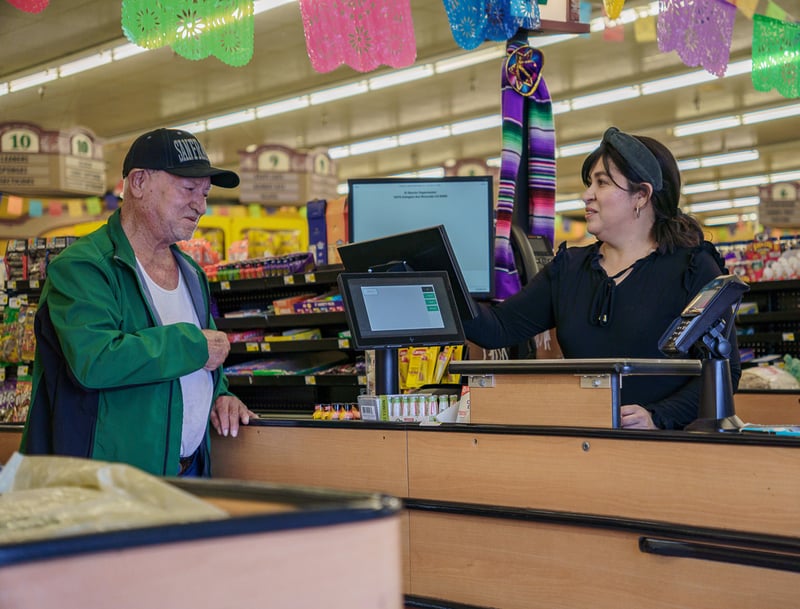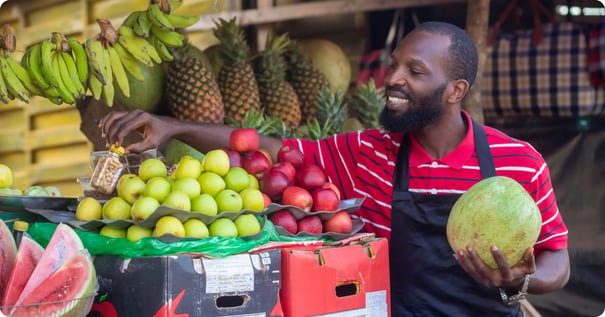
They introduce us to new cuisines , give people access to fresh, local food , and serve as a friendly hub for gathering and connecting with our neighbors.
But factors like inflation and competition from big-box stores make opening a new grocery store riskier than ever.
Creating a solid grocery store business plan helps you clear common hurdles and sets your business up for long-term success.
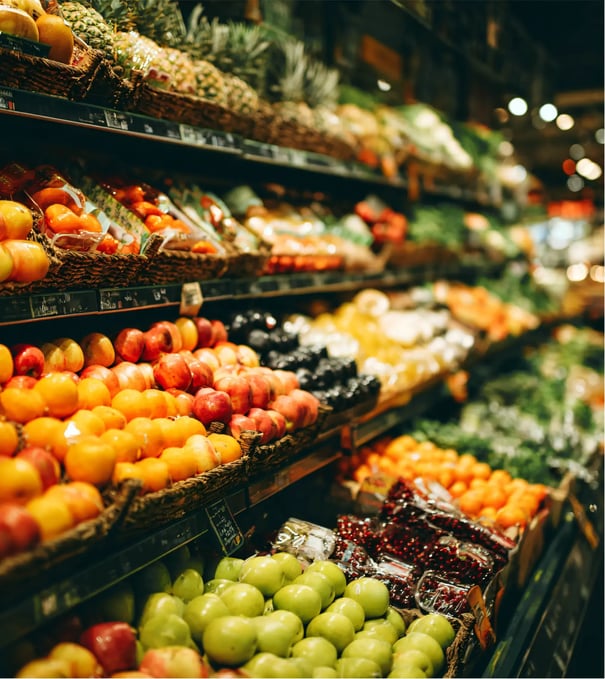
How much does it cost to open a grocery store in 2026? The answer can vary, but most estimates put the number between $80,000 and $300,000 . Larger locations can require up to $1 million in startup costs.
Part of why a business plan is so essential is that it helps you map and prepare for these costs before you invest any real money. Understanding these startup costs is critical when securing bank loans, choosing locations, and making other vital early decisions.
The most significant startup costs are:

Registering your business and applying for licenses is a necessary first step for any retailer. Licenses you’ll need include:
Seller’s permit/sales tax license, Resale permit, Retail food license, Food processor license, Liquor license*, Tobacco license*, Health permit, Zoning permits.
*Note: These licenses are only needed if you plan to sell liquor or tobacco at your store.
It’s worth noting this is not an exhaustive list. Check with your local chamber of commerce to understand your state’s requirements.

The average commercial rent in the U.S. is roughly $29 per square foot per year , and most leases require around three months’ rent upfront.
Location costs vary wildly based on your state, the size of the store, and whether you’re based in an urban or suburban location.

Most locations will require some renovations or repairs to get ready for opening. Unless you’re taking over an existing location, you’ll also need to invest in display cases, shelving, produce bins, refrigeration units, freezers, and signage.

To manage your store and ring up customers, you’ll need to invest in both back office and checkout technology , including:
Point of sale (POS) system, Touchscreens, Cash drawers and payment terminals, Barcode scanners and scanner scales, Deli scales, Barcode and label printers, Security cameras.

Stocking your shelves will be one of your biggest expenses, both when you start up and as you run the store. Planning your inventory in advance will help you define your niche and keep costs down.

You could spend nothing on marketing, but people won’t show up and shop if they don’t know your store exists. At a minimum, plan to pay for a website and some basic exterior signage for the store.

You can’t run your grocery store alone. Hiring and training great employees is essential for a small grocery store — we recommend allocating three months of staff payroll as part of your startup costs.

Any business with employees is required to have workman’s compensation at a minimum. However, it’s a good idea to invest in a more substantial business insurance plan to protect your assets from theft and losses.
We’ll go in depth into how to write a business plan below, but for an quick reference for what to include, download this handy checklist.

Starting a small grocery store can be incredibly rewarding, but it isn’t without its risks.

Increased inventory costs make it harder for new grocery stores to recoup their startup costs.
Almost all small grocery stores are competing with a big-box store down the street, and without a clear plan of attack, it’s hard to stand out.
Grocery profit margins are notoriously thin ( between 1–5% ), making it essential to have a solid sales and operational strategy.
Many small grocers lack tools to clearly see how their store is performing, meaning many lingering problems (and opportunities) go undetected.
When many new grocers are just starting out, they often lack solid supplier relationships and are unable to negotiate better terms or stay ahead of supply chain disruptions.
Unless a small grocery store can define a niche and market itself effectively, people won’t be as willing to take a chance on it.
Writing a business plan is a big job.
A typical business plan is typically 15 to 20 pages, but it can take anywhere from a few weeks to a few months to write , depending on your experience. Some store owners even pay for help to write their business plan — that’s for a good reason.
A solid business plan acts like a blueprint for your future success, and is well worth the effort. Let’s dive into the core components of a business plan for small grocery stores.
The executive summary will be one of the shortest parts of your business plan, but also one of the most important. This section lays out your hopes and dreams for your grocery store, how you’ll stand out from big-box competitors, and how you’ll help meet the needs of your community.
An executive summary should include information like:
Keep your executive summary to a few paragraphs or a page at the most. Remember, this part of the business plan should be inspiring, both for yourself and any potential investors. It should get you fired up and remind you why you wanted to open a grocery store in the first place.
Craft Your Mission Statement
As a starting point, try to boil your business down to a single sentence that serves as an elevator pitch. This will force you to narrow down your key value proposition. Here are some examples to get your creative motor running:
This mission statement acts like a north star for your business — something to check in with as you make important decisions to ensure you stay aligned with your vision.
The executive summary will be one of the shortest parts of your business plan, but also one of the most important. This section lays out your hopes and dreams for your grocery store, how you’ll stand out from big-box competitors, and how you’ll help meet the needs of your community.
An executive summary should include information like:
Keep your executive summary to a few paragraphs or a page at the most. Remember, this part of the business plan should be inspiring, both for yourself and any potential investors. It should get you fired up and remind you why you wanted to open a grocery store in the first place.
Craft Your Mission Statement
As a starting point, try to boil your business down to a single sentence that serves as an elevator pitch. This will force you to narrow down your key value proposition. Here are some examples to get your creative motor running:
This mission statement acts like a north star for your business — something to check in with as you make important decisions to ensure you stay aligned with your vision.
Conducting market analysis is essential to demonstrate that you understand your industry, the location and community you operate in, and the practical aspects of being successful.
Your market research won’t necessarily be its own section, but will be included in everything else you write. That’s why we recommend doing this step right after writing your executive summary.
Here are some questions you’ll be answering while doing market research:
As you might suspect, doing market research is one of the most time-consuming aspects of writing a business plan — but it’s vital both for showing investors how you’ll succeed in a crowded industry and for building your own knowledge about the grocery industry as a whole.
Market analysis is also vital for defining your niche. For example, there might be some corporate chains and convenience stores in your area, but no one that offers local produce or regional ingredients.

Conducting market analysis is essential to demonstrate that you understand your industry, the location and community you operate in, and the practical aspects of being successful.
Your market research won’t necessarily be its own section, but will be included in everything else you write. That’s why we recommend doing this step right after writing your executive summary.
Here are some questions you’ll be answering while doing market research:
As you might suspect, doing market research is one of the most time-consuming aspects of writing a business plan — but it’s vital both for showing investors how you’ll succeed in a crowded industry and for building your own knowledge about the grocery industry as a whole.
Market analysis is also vital for defining your niche. For example, there might be some corporate chains and convenience stores in your area, but no one that offers local produce or regional ingredients.
Once you’ve laid out your grocery dreams at a high level and finished your research, it’s time to dive into more detail. The business overview is your chance to show that you’ve put thought into the practical aspects of running your business.
Your business overview should highlight:
Some of this will overlap with your executive summary — that’s OK. If the goal of the executive summary is to generate excitement, the goal of this section is to show that you can back up that excitement with practical know-how.
Once you’ve laid out your grocery dreams at a high level and finished your research, it’s time to dive into more detail. The business overview is your chance to show that you’ve put thought into the practical aspects of running your business.
Your business overview should highlight:
Some of this will overlap with your executive summary — that’s OK. If the goal of the executive summary is to generate excitement, the goal of this section is to show that you can back up that excitement with practical know-how.
As a small grocery store, having quality stock will make or break your business. This section is your chance to provide a more detailed breakdown of the products and services you’ll offer.
Having a clear inventory plan helps new store owners make compelling product selections, reduce waste, and price competitively.
Rather than just create a list of brands or menu items, you’ll want to cover:
This is also a good time to determine what key performance indicators (KPIs) you plan to track to optimize your product mix, reduce costs, negotiate better rates with suppliers, and adjust pricing.
As a small grocery store, having quality stock will make or break your business. This section is your chance to provide a more detailed breakdown of the products and services you’ll offer.
Having a clear inventory plan helps new store owners make compelling product selections, reduce waste, and price competitively.
Rather than just create a list of brands or menu items, you’ll want to cover:
This is also a good time to determine what key performance indicators (KPIs) you plan to track to optimize your product mix, reduce costs, negotiate better rates with suppliers, and adjust pricing.
No matter how much passion you have, at the end of the day, your grocery store is a business — and it’s important to show you know exactly how you’re going to make money and turn a profit .
These are the essential numbers to include:
Understanding the numbers is crucial for approaching banks or the Small Business Administration for loans. More importantly, it sets financial targets that you can monitor to ensure your store is growing as expected.

No matter how much passion you have, at the end of the day, your grocery store is a business — and it’s important to show you know exactly how you’re going to make money and turn a profit .
These are the essential numbers to include:
Understanding the numbers is crucial for approaching banks or the Small Business Administration for loans. More importantly, it sets financial targets that you can monitor to ensure your store is growing as expected.
When writing your grocery store business plan, it’s easy to get bogged down in the numbers and logistics side of things. As a result, many store owners end up putting marketing on the back burner — we’re here to tell you that is a mistake .
Marketing your grocery store effectively is how you’ll keep yourself afloat in those first few months, build your reputation, and get people curious about your store.
First things first: Your marketing strategy isn’t only how you’ll promote the store before opening (though that is also part of it). Marketing includes everything from signage and websites to promotional events and discounting strategies.
Here are some marketing strategies to include as part of your business plan:
Grocery store marketing isn’t hard and doesn’t require a dedicated marketing person, but it can be easy to overlook. By figuring out the marketing strategies you plan to use in the planning stage, you can also budget for them.
When writing your grocery store business plan, it’s easy to get bogged down in the numbers and logistics side of things. As a result, many store owners end up putting marketing on the back burner — we’re here to tell you that is a mistake .
Marketing your grocery store effectively is how you’ll keep yourself afloat in those first few months, build your reputation, and get people curious about your store.
First things first: Your marketing strategy isn’t only how you’ll promote the store before opening (though that is also part of it). Marketing includes everything from signage and websites to promotional events and discounting strategies.
Here are some marketing strategies to include as part of your business plan:
Grocery store marketing isn’t hard and doesn’t require a dedicated marketing person, but it can be easy to overlook. By figuring out the marketing strategies you plan to use in the planning stage, you can also budget for them.
Having the right systems and hardware in place can make all the difference in giving your customers a modern shopping experience. Yet many grocery store owners end up with a cheap, generic point of sale (POS) system and hope for the best.
We’ve seen too many businesses work harder than they need to on basic tasks like tracking perishable inventory, selling items by weight, or digitizing their stock list — just because they rushed into a POS system that isn’t the right fit for their business.
Your choice of point of sale system will largely determine how your store operates, and is involved in everything from ringing up customers and managing customer loyalty to generating purchase orders (POs) and updating your stock levels. Determining your technology stack will inform many aspects of your business operations.
Many POS systems have similar features, but systems made for grocery stores include extras that will simplify your day-to-day. Here are the key features to look for:
Most grocery stores will also need a combination of some, or all, of the following hardware:
The software you choose will also play a big part in which hardware you can use. Not all POS systems are compatible with all types of hardware, so choose wisely.

Having the right systems and hardware in place can make all the difference in giving your customers a modern shopping experience. Yet many grocery store owners end up with a cheap, generic point of sale (POS) system and hope for the best.
We’ve seen too many businesses work harder than they need to on basic tasks like tracking perishable inventory, selling items by weight, or digitizing their stock list — just because they rushed into a POS system that isn’t the right fit for their business.
Your choice of point of sale system will largely determine how your store operates, and is involved in everything from ringing up customers and managing customer loyalty to generating purchase orders (POs) and updating your stock levels. Determining your technology stack will inform many aspects of your business operations.
Many POS systems have similar features, but systems made for grocery stores include extras that will simplify your day-to-day. Here are the key features to look for:
Most grocery stores will also need a combination of some, or all, of the following hardware:
The software you choose will also play a big part in which hardware you can use. Not all POS systems are compatible with all types of hardware, so choose wisely.
.png?width=147&height=34&name=POS-Nation-Logo-Main%20(1).png)