.png?width=147&height=34&name=POS-Nation-Logo-Main%20(1).png)





Liquor Inventory Software: Top 5 POS Providers for 2026
Your liquor store is busy. The register never stops. So why do the margins still feel tight? When sales volume doesn’t translate into profit, the issue usually isn’t demand — it’s visibility.
Category reports inform liquor store owners about the performance of different product groups — not just in terms of sales dollars, but also in terms of their contribution to profit.
Learn what category reports reveal, which product groups drive profit, and how liquor-specific point of sale (POS) tools help you act on that data.
What Are Category Reports?
Category reports group products by type — such as beer, wine, spirits, and mixers — and show how each performs in terms of sales volume, margin, and profit contribution, rather than isolating individual SKUs.
For liquor store owners who feel like everything sells but nothing stands out, this view changes how decisions get made.
Category reports typically:
-
Track total sales by product group.
-
Measure gross margin by segment.
-
Compare unit movement and sales velocity.
-
Calculate each classification’s contribution to the overall profit.
Your whiskey may fly off the shelf and dominate conversations at the counter, but a category report can tell a different story — showing that wine delivers higher profits with far fewer units sold.

When owners first review category reports, the most surprising insights usually come from what isn’t obvious on the sales floor. These summaries show what you can’t see from daily sales alone.
Here’s where category reports help identify the biggest profit gaps.
Slow-Moving SKUs That Tie Up Cash
Even fast-moving product groups can hide dead weight. A few underperforming stock keeping units (SKUs) can absorb shelf space and cash without drawing attention.
Segmented analysis helps you:
-
Identify products that sell unevenly (a flavored whiskey that sells heavily during promotions and then sits untouched for weeks).
-
Compare how quickly items move within the same category (a core vodka reordered weekly versus. a premium label reordered once per quarter).
-
Catch products that pull down category performance (multiple liqueurs holding shelf space with fewer than two sales per month).
Removing or reducing these SKUs frees up capital for products that turn faster and earn more per square foot.
Margin Imbalances Between Categories
Some product groups contribute more per sale than others. Even within the same group, margins can vary widely. To see where the shop earns most, owners need a way to compare performance at a broader level.
Category reporting allows you to:
-
Measure gross margin contribution by type (specialty liqueurs outperform fast-moving seltzers in profit per unit).
-
Compare profit per unit instead of just revenue (margins on a craft six-pack versus a domestic case).
-
Detect segments that need pricing or mix adjustments (spirits with steady sales but shrinking returns).
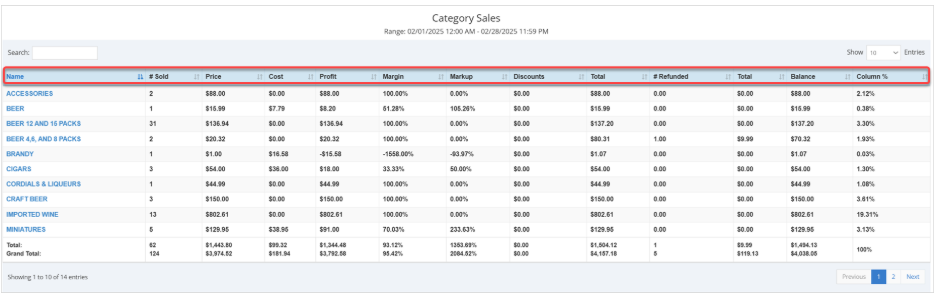
In the example report below, beer earns $8.20 per sale, while imported wine brings in just over $61 per bottle. Seeing that difference, you shift more shelf space toward wine and fine-tune pricing on high-volume beer so it contributes more to profit.
Seasonal Trends You Can Plan Around
Liquor sales follow predictable seasonal shifts, but many stores react rather than prepare for them. Category reports turn patterns into planning tools.
With clearer performance data, you can:
-
Review category results across months and quarters.
-
Identify seasonal patterns before they affect inventory decisions.
-
Adjust orders and displays ahead of peak periods.
If you consistently see a spike in domestic lagers during summer and sparkling wines around the holidays, you can plan inventory, promotions, and displays earlier.
Some categories don’t perform well on their own but help lift profits when paired correctly. Mixers, bitters, and ready-to-drink (RTD) products often fall into this group, especially when positioned alongside core spirits.
Understanding category-level KPIs helps you:
- Highlight categories that perform better with bundling or placement changes.
- Expose attachment patterns across related product types.
- Enable deliberate upsells based on buying behavior.
You may find that placing orange bitters next to bourbon and agave syrup, or margarita mix beside tequila, encourages add-on purchases and increases the average transaction value. Once those pairings are visible, merchandising becomes more intentional — and more profitable.
Turning Insights Into Action With POS Reporting Tools
Seeing the data only matters if you can act on it quickly. Liquor store POS systems automate category tracking and surface insights in real time, so you can identify issues early and adjust pricing, ordering, or placement before margins slip.
With the in-depth POS reporting, stores can:
- Rank categories automatically by sales and margin.
- Trigger reorder alerts based on how fast each category moves.
- View profit by category as sales happen, not weeks later.
For independent liquor shops, that visibility supports quicker adjustments to pricing, ordering, and placement, helping you grow from a high-volume store to a consistently profitable one.
Take Control of Your Margins With Automated Category Reports
If you’re selling plenty but profits still feel elusive, the issue isn’t a lack of effort. It’s insight. Without category-level visibility, stores often reinvest capital into low-return inventory without realizing it.
POS Nation connects you with liquor store POS solutions that show how categories actually perform. See which products earn more per sale, which categories support margins, and where small changes make a measurable difference — all as sales happen.
Schedule a live demo to see what your shop’s category reports can reveal and how they support better margin control.


Spence started out selling point of sale technology to cigar stores. He was so passionate about providing an industry-specific solution to tobacco shop owners that he started his own business: Cigars POS. Spence believes small business owners are essential to thriving communities. He writes passionately about marketing, inventory management, and POS software — three topics he believes every tobacco store owner should learn about. "I've seen firsthand how much courage it takes to build a thriving business. That's why I'm passionate about helping store owners make smarter inventory decisions that keep products moving and cash flow healthy. Small businesses are the backbone of thriving communities, and I'm committed to giving them the tools they need to succeed."